As per tradition there's a typo on the title card.
kdenlive could really use a spell-checker (or maybe it has one
and I just shouldn't make movies in a rush).
Spoiler Warning
This is just four different demoscene effects, along with some bytebeat music.
Requirements
This requires a terminal emulator that supports 24-bit ANSI colors.
These days most Linux terminal emulators do, including stock xterm
(at least on Debian).
There is sound too! On a Debian system at least if you have
/usr/bin/aplay
it will attempt to pipe the sound into it at the default 8kHz/8-bit unsigned.
Bugs
???
Obfuscation
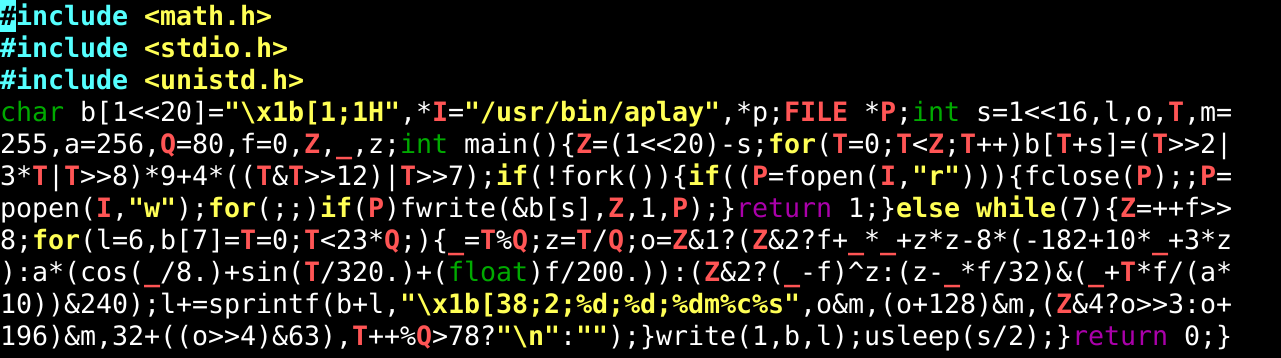
I did this at the last minute and it ended up being mostly a size-coding
exercise rather than any true obfuscation. All the graphics are the
result of a very complex ternary expression though.
It is 681 bytes of C code, I had hoped to get it down to 512 bytes but
ran out of time.
Background
The Audio
Bytebeat music is a genre where the music is made purely by math.
One common form of it is just a C expression that takes a single
argument, usually t for time, and it generates the sample for that
timestep. The assumption is the output is treated as raw 8-bit audio
to be played at 8kHz.
The bytebeat used here is:
buffer[t]=(t>>2|3*t|t>>8)*9+4*((t&t>>12)|t>>7);
This is based on a bytebeat by Tjoppen for use on 6502 processors,
and was itself based on a combination of entries by viznut, xpansive,
and varjohukka in a thread on pouet.net.
I took the baseline and modified the weights to be generated by
a random number generator. Then I tried a large number of these randomly
generated weights until I found one that I thought sounded interesting.
I had hoped to have a few more effects but the ones I tried did not
really look that great at 80x24 resolution.
The Visuals
There are a series of four visuals that are cycled through. Each one
the pattern can be generated solely based on the x and y co-ordinates.
The idea for this is roughly based on the (much more impressive)
256-byte MS-DOS "Memories" demo by Hellmood.
There are two palette variants, so 8 visuals total. It would have been
easy to add more but you're probably getting irritated by the music
by that point.
Plasma
This is a plasma effect made with sine and cosine. It's why we have
to link against -lm. This one if vaguely based on the low-res
Apple II effect from the French Touch "Plasmagoria" demo.
Sierzoom
Rotozoom effect with Sierpinski triangles. You're only seeing small
chunks of it here, due to low resolution, and also because what you
see varies a lot based on the current frame.
Circles
A Memories-inspired effect. Nothing fancy here, just animated circles
made with x**2+y**2